
How an Information Asset Register (IAR) Simplifies Compliance in Queensland Agencies and Non-Government Organisations
As a cyber security firm working closely with Queensland Government agencies, we understand the growing frustration of managing the compliance landscape that is becoming increasingly complex, especially with the introduction of the Information Privacy and Other Legislation Amendment Act 2023 (IPOLA), which came into effect on 1 July 2025.
Queensland agencies are expected to meet obligations under multiple standards/frameworks and acts, each with its own set of requirements for managing information assets. Here’s a snapshot of the current compliance requirements for information assets.
IS44
- Identify and register information assets, and assign custodianship
IS18
- Implement an Information Security Management System (ISMS) based on ISO 27001 Accountable officers must obtain security assurance for systems relative to the asset
Public Records Act 2023
- Maintain privacy and security of records throughout their lifecycle
IPOLA Requirements
- Data Breach Register
- Personal Information Register
- Privacy Risk Register
- Data Breach Policy and Response Plan
QGISCF
- Apply classification labels to all information to indicate confidentiality level and document the highest business impact assessed for the influence on confidentiality, integrity and availability
QGAF
- Ensure authentication requirements are met under the IP Act 2009
QGEA
- An overarching guide on how to govern information assets and manage them through their lifecycle
Figure 1: Current Compliance Requirements
The problem is fragmented registers, overlapping requirements, and duplicating data. Each of these policies and acts requires you to track, classify, and manage information assets, often in separate registers. This leads to duplication, inconsistent data, and increased administrative overhead.
What is the Solution?
The solution is a consolidated Information Asset Register (IAR). To streamline compliance and strengthen cyber security, we recommend implementing a single, comprehensive IAR that consolidates all required attributes from different registers into one place. This approach not only simplifies your governance processes but also enhances the Confidentiality, Integrity, and Availability (CIA) of your information assets.

Figure 2: Confidentiality, Integrity, and Availability of Information Assets
Simplify and Secure Information Asset Management
A single IAR supports your breach response requirements under IPOLA. Under the Mandatory Notification of Data Breach (MNDB) scheme, agencies must report breaches involving personal information that may cause serious harm.
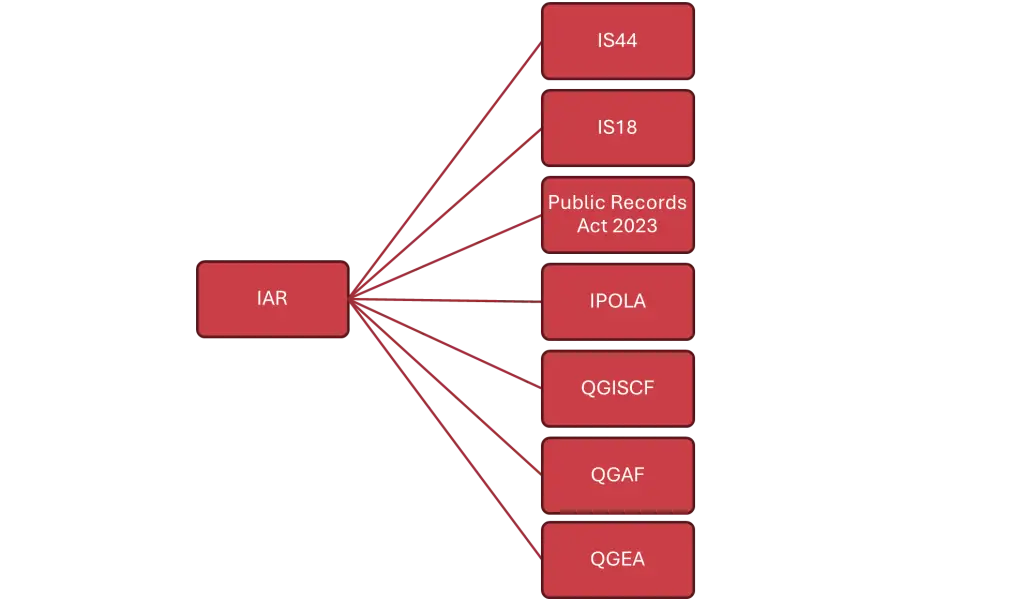
Figure 3. IAR Integrating Policy and Standard/Framework Requirements
A consolidated IAR supports this by:
- Identifying the scope of a breach – Quickly locate affected assets and systems.
- Determining if personal information is involved – Filter and sort assets to assess exposure.
- Assessing potential harm – Understand the nature of the data and its sensitivity to guide decision-making.
Even more so, the IAR enhances risk management and Business Impact Awareness. By including Business Impact Level (BIL) classifications and privacy/security flags in your IAR, you gain a clear snapshot of:
- Which assets are most valuable
- Where your highest risks lie
- What mitigation strategies are in place
This supports risk assessments, strategic planning, and business continuity efforts.
In summary, a single IAR:
- Reduces duplication and administrative burden.
- Improves data quality and governance.
- Supports compliance across multiple Queensland Government policies and frameworks.
- Enables faster breach response and risk analysis.
- Strengthens cyber security posture through the application of CIA principles.
If you’re ready to simplify your compliance journey and improve your agency’s information governance, we can help you implement a tailored IAR solution that meets all these requirements.
How?
There are three ways this can be done.
1. Do It Yourself
The Office of the Information Commissioner (OIC) provides quick guides and templates to help you step through the process. It’s a great starting point if you have internal capacity and want to build your IAR in-house. The following resource will start you on your DIY journey:
2. Guided Support
Let us walk you through it – If you’d prefer expert guidance, we can work with you directly by:
- Explaining what’s required,
- How to structure your register, and
- How to align it with your compliance obligations.
3. End-to-end IAR Implementation – We’ll Do It for You
We offer a fully customised IAR solution, built using our proven framework. It includes traceable metadata aligned with IS44, IS18, IPOLA, and other key policies, plus supporting procedures and documentation to ensure your agency is audit ready and compliant.
Not a Government Agency? This Still Applies to You!
While this framework was designed with Queensland Government agencies in mind, the benefits of a consolidated IAR extend to private sector businesses, non-profits, and educational institutions too.
If your organisation handles personal or sensitive information, faces regulatory obligations, or needs to manage cyber security risks, an IAR can help you:
- Simplify compliance across privacy, cyber security, and contractual requirements.
- Strengthen your cyber security posture by improving CIA of your data.
- Respond faster to incidents by having a clear view of what data you hold, where it lives, and who’s responsible.
Whether you’re governed by the Privacy Act 1988, ISO 27001, or industry-specific standards, a well-structured IAR is a strategic asset that supports governance, risk, and compliance.
If you’re ready to streamline your data governance and reduce risk, we can help you tailor an IAR solution that fits your organisation’s needs.